Areas of Support
We help communities and partners strengthen the foundations of capital that support local wellbeing.
Areas of support
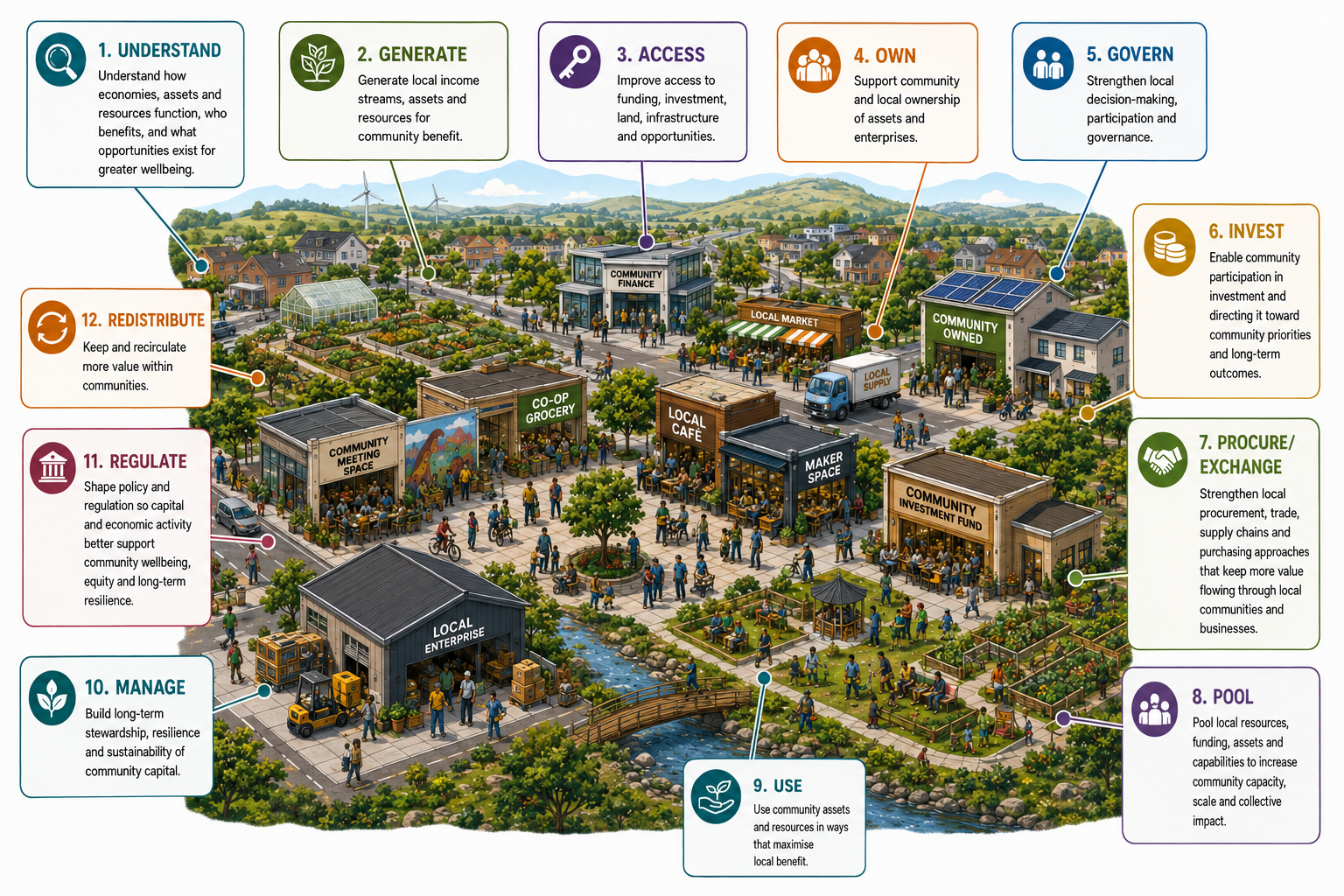
We help you build confidence, knowledge, and capacity across the essential Functions of Community Capital — the ways capital is generated, accessed, owned, governed, invested, used and redistributed to support community and economic wellbeing.
We support communities and collaborators to develop these essential functions in ways that are more place-based, people-centred, locally owned, inclusive, and equitable, helping to build self-reliance, resilience, and regeneration over time.
We connect you with the narratives, practices, strategies, structures, vehicles, institutions and policies needed for communities to fund what matters, own what they need, and build social and economic systems that serve them.
Understanding Community Capital - The Fundamentals
What it is
Community capital fundamentals explores the essentials — what capital is, how it functions, and why it’s foundational to the wellbeing of people and place. It introduces the core functions of capital — how it’s generated, accessed, owned, governed, invested, and shared — and helps communities and collaborators understand the systems that shape local prosperity.
Why it matters
Capital underpins how communities function and thrive. It determines who has access to resources, how value is created, and who benefits. Yet, in many places, capital systems have become fragmented or extractive — limiting community control and local opportunity. Understanding capital gives people, organisations, and governments the ability to see where change is needed and how to direct resources toward shared wellbeing.
How community capital does it differently
Community capital takes a place-based, people-centred, and regenerative approach. It focuses on building capital systems that are locally owned, inclusive, and designed to deliver benefits that last — ensuring that prosperity is shared and wellbeing is strengthened over generations.
Generating Community Capital
What it is
Generating community capital is about identifying and creating new sources of local funding, income, assets, and capital value that support community and economic wellbeing.
Why it matters
Communities need the ability to generate their own capital to drive change, reduce dependency on external funding, and invest in what matters locally. This means more than just generating money — it includes developing enterprises, infrastructure, land, and other assets that create ongoing local value. When communities can create, grow, and manage these forms of capital, they build stronger economic foundations, greater self-reliance, and the power to shape their own futures.
How community capital does it differently
Community capital focuses on generating these assets in ways that are community-led, locally grounded, inclusive, and regenerative. This ensures that the benefits of new assets, enterprises, and opportunities stay within the community — strengthening long-term wellbeing for people and place.
Accessing Community Capital
What it is
Accessing community capital is about improving the ability of families, communities, and local organisations to connect with — and access — the funding, assets, and investment they need to achieve their goals. It’s also about improving the ability of those who hold capital within the community to make it available, accessible, and aligned with local priorities.
Why it matters
Communities thrive when they can access the capital they need to realise their own ideas and ambitions. Local access means local control — it gives communities the power to act quickly, design their own solutions, and share benefits more fairly. By connecting those who need capital with those who hold it, communities unlock underused resources, build mutual confidence, and create a more resilient local economy that works for everyone.
How community capital does it differently
A community capital approach focuses on unlocking and aligning local capital first — building readiness, relationships, and mechanisms that make it easier for capital to move within a place. Once local systems are connected, it also becomes easier and more strategic to attract external investment that complements, rather than replaces, local ownership and control.
Acquiring & Owning Community Capital
What it is
Acquiring and owning capital is about securing control over the assets that underpin local prosperity — such as land, buildings, enterprises, infrastructure, technology, and intellectual property. Ownership determines who makes decisions, who benefits, and how value is distributed over time.
Why it matters
When communities can acquire and own key assets, they move from being passive participants in development to active stewards of their own futures. Ownership gives communities the power to shape how land is used, how businesses operate, and how local value circulates. It anchors wealth in place, provides security for future generations, and allows profits and benefits to be reinvested in priorities like housing, jobs, services, and the environment. Without ownership, communities remain vulnerable to decisions and markets beyond their control.
How community capital does it differently
Community capital emphasises inclusive, shared, and purpose-driven ownership — through models such as cooperatives, trusts, community enterprises, and joint ventures. These approaches ensure that control and value remain in local hands while generating benefits for the wider community. By distributing ownership more broadly, communities can balance economic success with social equity, resilience, and long-term wellbeing.
Governing & Managing Community Capital
What it is
Governing and managing capital is about how decisions are made, who participates in them, and how resources are stewarded for long-term community benefit. It includes the structures, processes, and leadership that ensure community assets — whether financial, physical, or natural — are cared for, maintained, and used wisely to create lasting value.
Why it matters
Strong governance builds the foundations of trust, transparency, and accountability. It ensures that communities retain influence over how capital is used, who benefits, and how risks are managed. Effective management keeps assets productive and sustainable — preserving their value, avoiding misuse or depletion, and ensuring that benefits are distributed fairly across people and generations. Without effective governance and management, even well-intentioned initiatives can lose direction, waste value, or erode community confidence.
How community capital does it differently
Community capital prioritises local leadership, inclusive governance, and collaborative stewardship. It helps communities develop the systems, skills, and confidence to manage capital responsibly and transparently. Decisions are guided by shared values, local priorities, and intergenerational wellbeing — ensuring that community capital serves people and place now and into the future.
Pooling Community Capital
What it is
Pooling capital is about combining local assets and resources to create greater collective strength and opportunity. These resources can include money, land, buildings, equipment, natural assets, skills, or knowledge — anything that holds value and can contribute to community goals. Pooling can take many forms, such as establishing community funds, cooperatives, crowdfunding campaigns, shared ownership structures, or local investment groups.
Why it matters
When communities pool what they already have, they unlock hidden potential. Pooling enables collaboration, builds trust, and creates the scale needed to take on shared priorities such as housing, local enterprise, renewable energy, or infrastructure. It allows communities to move from individual efforts to collective action, making better use of existing resources before seeking external support.
How community capital does it differently
A community capital approach emphasises local, inclusive and transparent pooling that reflects local priorities and values. It helps communities bring together diverse assets in ways that build shared ownership and long-term benefit — ensuring that resources are used cooperatively, generate mutual value, and strengthen the wellbeing of people and place.
Investing Community Capital
What it is
Investing capital is about directing pooled resources into projects, assets, and enterprises that create value and deliver lasting community benefit. Investment can take many forms — financial, physical, social, or environmental — and is guided by the community’s vision for prosperity and wellbeing.
Why it matters
Investment turns potential into progress. When communities can invest their own capital, they gain greater control over local development, create meaningful jobs and services, and keep profits circulating locally. Strategic, values-aligned investment also attracts partners and external co-investment that strengthen long-term prosperity.
How community capital does it differently
Community capital invests through locally governed, purpose-driven structures that align financial returns with social, cultural, and environmental outcomes. It ensures that the benefits of investment — from income to improved infrastructure and wellbeing — stay in community hands, supporting systems that are regenerative rather than extractive.
Managing Community Capital Risk
What it is
Managing capital risk is about understanding and mitigating potential threats to community assets, investments, and enterprises — including financial, environmental, social, and governance risks.
Why it matters
Every community initiative involves risk. Managing it effectively protects local assets, ensures continuity, and builds confidence among investors, partners, and residents.
How community capital does it differently
Community capital approaches risk management through shared accountability, diversification, and long-term resilience. It encourages transparent decision-making, collective learning, and risk-sharing structures that balance innovation with protection of community value.
Exchanging Community Capital
What it is
Exchanging capital is about how communities trade, collaborate, and share assets — through markets, partnerships, and networks — to build stronger local systems.
Why it matters
No community thrives in isolation. The ability to exchange capital — whether financial, built, institutional, natural, or social — increases access to resources, strengthens relationships, and fosters innovation and mutual support.
How community capital does it differently
Community capital promotes reciprocal, values-based exchange that benefits all participants. It encourages collaboration across sectors and places, ensuring that trade, investment, and partnerships contribute to shared wellbeing rather than extraction.
Redistributing Community Capital
What it is
Reinvestment and redistributing capital is about directing profits, benefits, and value back into the community to create ongoing prosperity, equity, and opportunity.
Why it matters
Reinvestment and redistribution ensure that community gains are not lost but multiplied over time. It supports continuous improvement, local ownership, and fairness in how value is shared.
How community capital does it differently
Community capital embeds local benefit and fairness at the heart of reinvestment — ensuring that returns are used to strengthen shared assets, expand opportunities, and deliver lasting wellbeing for all.
Collaborating on Community Capital
What it is
Partnering and collaborating on capital is about working with external actors — such as governments, investors, philanthropists, corporations, and other stakeholders — to align and amplify community-led capital systems. Collaboration can take many forms, including co-designing projects, co-investing in local initiatives, or sharing ownership of assets and enterprises that deliver mutual value.
Why it matters
External partners bring resources, expertise, and influence that can help communities scale impact and achieve ambitious goals. Effective partnerships can open doors to new funding, innovation, and market opportunities. But without alignment, these relationships can unintentionally disempower communities or extract value from local assets — reinforcing dependency rather than building resilience.
How community capital does it differently
A community capital approach fosters co-ownership, co-investment, and co-design grounded in respect, transparency, and shared purpose. It ensures that partnerships strengthen local capability, ownership, and wellbeing, creating value for both the community and the partner.
Natural Capital & Environmental Markets
What it is
Natural capital and environmental markets help us recognise the true value of nature — and create new ways to invest in, protect, restore, and share in its benefits. Our work focuses on building the knowledge, skills, and confidence of communities, landholders, and regional organisations to actively participate in, shape, and benefit from these emerging markets.
Why it matters
As investment in nature grows, communities’ risk being left behind or reduced to service providers without power or ownership. We help ensure these markets strengthen local economies, stewardship, and self-determination — not external extraction.
How we do it differently
We focus on upskilling and empowering communities, CMAs, NRM organisations and landholders to lead, innovate, and participate on their terms. Through practical learning, networks, and tools, we help build local capacity and entrepreneurial readiness, so natural capital and environmental markets deliver lasting benefit for people and place.